
Hermès Scarf Guide: Artists, Styling and Care
Quick answer
This Hermès scarf guide helps you choose a format, recognise artist designs and wear the silk with clothes you already own. Start with the colourway, construction and condition, then compare the documented design and edition. Sold Attire brings together Carré 90 history, collector references, practical styling and care for buyers in Cairo and across Egypt.
By Yahya - Founder & Lead Authenticator, Sold Attire · Updated September 2026
“A carré shows its maker at the edge: silk density, print registration and a rolled hem that should survive close inspection.”
A scarf can hide its construction when you see it folded around a neck or tied to a bag. Open it flat and the evidence appears. The square must hold its geometry. Fine lines should meet without blurred colour. The hem has to feel deliberate under the fingers, and the silk should carry enough body to drape without collapsing.
Hermès changed how collectors read a scarf. Its Carré 90 gave illustrators a fixed silk frame and gave buyers a portable work that could be worn, stored, studied and reissued in new colours. Bags may dominate conversations around the maison today, yet silk offers the clearest entry into its approach to drawing, colour and hand finishing.
For a buyer in Egypt, a vintage Hermès scarf also solves a practical problem. It offers access to the house without the price or boutique friction attached to a Birkin or Kelly. That lower entry point attracts replicas, altered scarves and vague listings. You still need to identify the format, motif, period and condition before deciding what the piece is worth.
How Did Silk Scarves Enter Modern Dress?
People wore cloth around the neck and head long before fashion houses printed their names on silk. Soldiers used neck cloths for protection and identification. Travellers covered themselves against dust. Workers tied squares around the head or neck because fabric could absorb sweat, secure hair and fit inside a pocket. Silk changed the category because it carried colour with little weight. European courts had used imported silk and silk woven in Europe for centuries, while nineteenth-century advances in textile printing made complex repeat patterns and pictorial designs easier to produce at scale. By the early twentieth century, designers could treat a scarf as a finished composition rather than leftover fabric from a dress.
The motorcar helped move the silk scarf into daily fashion. Open cars exposed passengers to dust and wind, and women wrapped long scarves around hats, hair and necks. Aviation added another visual language. Pilots used silk for warmth and because the smooth cloth reduced chafing. Fashion magazines then moved the scarf from equipment to styling: a narrow tie, a head wrap, a shoulder drape.
Hermès entered this history from a different direction. Thierry Hermès opened his Paris harness workshop in 1837. The house understood horses, travel and the equipment people carried before it worked in printed silk. That equestrian archive later gave its illustrators a deep library of bridles, carriages, uniforms, maps and animals.
When Did Hermès Create the Carré 90?
Hermès introduced its first silk twill carré in 1937, one hundred years after Thierry Hermès founded the house. Robert Dumas, the son-in-law of Émile Hermès, developed Jeu des Omnibus et Dames Blanches. The design referenced an old board game and Parisian horse-drawn transport. It connected the new silk métier to the house's equestrian past without turning the scarf into a repeated logo. The word carré means square in French. The original format measured about 90 by 90 centimetres, although hand finishing can produce small variations. Hermès still uses the Carré 90 as a central format while offering smaller squares, narrow Twillies and large shawls.
The fixed square gave artists a useful constraint. A design had to work flat, where a collector could read the whole scene, and folded, where only a border, horse, wheel or line of colour might remain visible. The best scarf drawings carry several compositions inside one square. A different fold changes the part of the image you wear.
Hermès has revisited older motifs in new colourways and materials. A design's first issue date therefore does not date every scarf carrying that image. The artist, print mark, care label, silk, colourway and construction must agree with the period claimed by the seller.
Four dates that frame Hermès silk
| 1837 | Thierry Hermès opens his harness workshop in Paris. |
| 1937 | The house introduces its first silk twill Carré 90. |
| 1966 | Henri de Linares first issues Gibiers, later revisited in other colourways. |
| Today | The silk collection spans Carré 45, 70 and 90 formats, Twillies, 140 shawls and other shapes. |
Why Did the Carré 90 Become the Hermès Standard?
Ninety centimetres gives the illustrator room for a complete scene and gives the wearer enough silk for many folds. You can knot a Carré 90 at the neck, wear it over the shoulders, wrap it over the hair or fold it into a band. A smaller square loses some of that range; a 140 demands more space and creates more volume. The silk twill supplies structure. Look across the cloth in good light and you can see the fine diagonal rib of the weave. The material should feel smooth but substantial. It should take a fold and release it with movement. Age, wear and cleaning soften the hand, so a vintage scarf should not be judged against a new one without allowing for its history.
The square also functions as an archive. Hermès commissions artists and credits many designs by name. Collectors follow certain illustrators, subjects and first-issue periods. Equestrian scenes form one lane, but the archive also covers cars, wildlife, architecture, mythology, travel and abstract graphics.
This combination of a fixed format and changing artwork explains why buyers often collect Carré 90 scarves in groups. The construction remains familiar while every motif creates a different object. A collector can compare colourways of one design or follow an artist across several decades.

Sold Attire: choosing silk for your wardrobe
An Hermès scarf earns its place through the clothes you wear with it. At Sold Attire, we would start with your most repeated outfit: a white shirt and jeans, navy tailoring, or a plain evening dress. Choose silk that brings a useful colour to that outfit and sits comfortably near your face. You can change the visible design by folding the same square in another direction, so one piece offers several ways to dress. Its value in your wardrobe comes from those repeated uses, alongside the pleasure of owning a drawing you enjoy looking at.
Consider the border before the centre. A large illustrated scene may disappear inside a narrow fold, while its navy edge becomes the part you wear every week. Open the scarf, fold it, then hold it against your shirt. We would make the buying decision after all three views.
For a first scarf, our recommendation is a colourway that works with two outfits you already own. For a second, choose something with a different scale or mood: perhaps a wildlife drawing after an equestrian design, or clear blocks of colour after a dense print.
Which Hermès artists and collaborations would Sold Attire look for?
We would build a collector shortlist around the artist, the drawing and the exact edition. Hermès silk includes recurring artist-designed collections as well as the separate Éditeur art projects, and those deserve different kinds of attention. Start with the examples below to decide whether you prefer wildlife, narrative illustration or abstraction. We recommend them for their documented creative interest and the different ways they can work in a collection. A claim that a scarf is sought-after still needs evidence for that design, colourway, format and condition; the artist's name alone is not a reason to accept a premium.
Robert Dallet: wildlife with room to study
Look at Jungle Love and Équateur if you enjoy animal drawings. Dallet's archive dates their original designs to 2000 and 1988 respectively and documents later versions. That makes his work useful for learning how one drawing returns in different treatments. Our recommendation: compare the full composition and the folded border before choosing a colourway. Robert Dallet archive.
Alice Shirley: colour and the natural world
Hermès credits Alice Shirley with Rewilding Nature, whose four corners explore different restored habitats. We would consider this kind of detailed nature drawing when a wardrobe already contains plain shirts, denim and solid-colour dresses. Let one colour in the scarf connect to the clothes, without trying to match the entire print. Hermès design notes.
Kermit Oliver: begin with the artist
The Museum of Fine Arts, Houston documents Oliver's work across painting, works on paper and Hermès scarf designs. We would approach his silk as part of that wider practice: identify the drawing, examine its details, then research the particular edition. His biography adds context, but the individual scarf still has to earn your interest. Museum of Fine Arts, Houston.
Josef Albers: the square as a study in colour
The Éditeur project adapted Albers' Homage to the Square work to silk. The Albers Foundation describes inks applied directly to white silk without overlapping layers. This is a reference for someone drawn to abstraction and the relationship between colours. It is an edition based on his work, rather than a new design personally commissioned from him. Albers Foundation.
Daniel Buren: an Éditeur reference
Hermès presented Buren's Photos-souvenirs au carré in 2010. We would include it on an art-focused sourcing list and ask for documentation of the exact example offered. Keep that search distinct from choosing a first scarf for daily wear. Maison Hermès exhibition history.
Hiroshi Sugimoto: colour translated from light
For Couleurs de l'ombre in 2012, Hermès and Sugimoto translated selected Polaroids into silk. The project comprised 20 designs, with seven examples of each. These 140 cm squares belong in a discussion of documented limited art editions. Our recommendation is to study the colour and provenance before discussing a purchase, and to avoid treating limited production as a promise of future value. Maison Hermès edition details.
Which Hermès Scarf Size Should You Choose?
Choose by how you plan to wear the silk. A Carré 90 gives the broadest range and the clearest view of a detailed motif. A Twilly works as a narrow accent. A large 140 creates a shawl rather than a small neck scarf. Measurements can vary by a centimetre or two because artisans finish edges by hand and vintage silk may shift after cleaning or storage. A seller should provide the measured dimensions of the exact scarf instead of copying a catalogue size.
Cairo weather makes the 70 and 90 useful for different reasons. The 70 creates less fabric around the neck during warmer months. The 90 gives more styling range and shows a detailed archive print better. A Twilly works when you want colour without wearing a full square.
Choosing a colourway around your clothes
Our starting recommendation is a Carré 90 when you want one square to try at the neck, over a shoulder and as a hair covering. A smaller square or a Twilly makes sense when you prefer a compact accent and less fabric around the neckline. A larger format suits draping, but check the composition because silk and cashmere-silk pieces do different jobs. Before choosing, try the fold you intend to wear and check the measured size of the actual scarf. The best format for you is the one that feels comfortable when tied.
| Your wardrobe | Sold Attire would start with | Try it this way |
|---|---|---|
| Navy, denim and white shirts | A navy-edged print with cream or warm accents | A narrow fold inside an open collar |
| Black dresses and evening separates | A drawing with a visible border or one clear colour | A loose triangle across one shoulder |
| Stone, olive and brown leather | Khaki, cream or muted gold tones | A small neck knot with a plain shirt |
| Colourful clothing | A restrained colourway or a print sharing one outfit colour | A short fold that leaves space around the neckline |
For a concrete example, Hermès Carré 90 Kosmima in navy and khaki gives us a palette we would pair with a cream shirt and olive trousers. The jewellery drawing can also work against a plain dark dress. The listing discloses thread wear, edge fraying and stored odour, so we would discuss those details before choosing it for frequent wear.


How Is an Hermès Scarf Printed and Finished?
An artist begins with a drawing. Hermès then translates that drawing into printable areas of colour. Traditional screen printing separates the image into individual colours, each requiring its own screen and alignment. Fine registration keeps borders, lettering and small pictorial details from drifting into one another. Hermès maintains a colour library containing more than 75,000 shades. Colourists can return to an established design and change its mood without changing the drawing. Navy and cream can make a mechanical motif feel restrained; orange and pink can push the same lines into another register.
The atelier prints on silk twill, then finishes the square with a rolled hem. The artisan rolls the edge into a narrow cord and secures it with small stitches. On many traditional Carré 90 scarves, that roll sits towards the printed face. Construction varies by format and period, so inspectors should compare the whole scarf to a documented reference instead of rejecting a piece on hem direction alone.
Handwork produces control with small variation. A hand-rolled edge should not look like a wide machine hem or a flat overlocked edge. The stitches can show measured irregularity on an older scarf that has relaxed through wear. Tight uniform loops from an industrial overlocker belong to another construction.
How Do You Authenticate a Vintage Hermès Scarf?
Hermès does not authenticate pieces bought outside its official network. A pre-owned buyer therefore needs a seller who can explain the decision and back it after purchase. Sold Attire examines ten connected areas rather than treating one mark as proof. A printed “Hermès Paris” mark cannot carry the decision by itself. Replicas reproduce text. Some genuine scarves hide the mark inside a dense drawing, and vintage labels may differ from current production. Inspect the silk and construction first, then use the printed and sewn details to test the period.
Ask for these photographs before buying online
- The full scarf laid flat, front and reverse.
- All four corners and several sections of the rolled hem.
- The house mark, artist signature and care label.
- Close views of stains, pulls, fading or repairs.
Read the broader Sold Attire authentication guide for the evidence standard behind our pre-owned work. Every approved scarf receives the same buyer protection described in our Lifetime Authenticity Guarantee.
Identifying the drawing and the edition
Begin with a photograph of the scarf opened flat, then record its design name, any artist signature, house marks, dimensions and material label. Compare the whole composition with a documented reference, including the border and small details. Keep the first release of the design separate from the production date of the piece in front of you. A later issue can carry an older drawing. At Sold Attire, we would leave a date unresolved when the evidence does not support it, rather than turn a familiar motif or one label into a precise year.
Ask for the front and reverse, all four corners, the full hem and close views of marks or repairs. A useful archive entry should make those comparisons possible. A design-name match identifies the artwork; it does not authenticate the silk or establish the edition.
Our Hermès Carré 90 guide covers construction and authentication in more detail. Use this archive alongside it when comparing an artist or design.
How Do Motif and Condition Affect a Vintage Hermès Scarf?
Buyers value design, colourway, artist, issue period and condition together. A sought-after motif in a weak colour for your wardrobe may remain unworn. A less famous design in colours you use can deliver more value. Scarves reward personal collecting because the market does not reduce every decision to one model and one leather. Condition affects use and price. Edge fray can worsen when you knot the scarf. Thread pulls interrupt the surface and may catch on jewellery. Perfume, makeup and storage odour require disclosure because silk holds scent. Sun fading often appears as uneven colour when the scarf has been framed or stored with one section exposed.
Our handled archive shows those differences:
Automobiles in Navy
Hermès Carré 90 Automobiles Navy Silk Scarf. The classic-car drawing links Hermès silk to the house's broader language of travel and movement. Our 88 by 89 cm example carried an SA Score of 8.5 out of 10, with marks, discolouration and storage odour disclosed. It is now sold and remains useful archive proof because the navy field makes print registration and wear easy to compare.
Les Quatre Saisons in Grey
Hermès Carré 90 Les Quatre Saisons Silk Scarf. Seasonal animal panels change as the square is folded. Our archive example measured 88 by 89 cm and carried an SA Score of 8 out of 10. We recorded creasing, lint, a thread pull, edge fray, marks and storage odour. The print remained wearable, but the condition report gave the buyer a realistic basis for use.

Gibiers by Henri de Linares
Hermès Carré 90 Gibiers Black Brown Silk Scarf. Henri de Linares first issued the game and wildlife design in 1966, and later versions exist. Our black and brown archive piece had odour, thread unravelling and fray recorded despite an SA Score of 9 out of 10. A named motif and strong print do not erase condition. They give you more reasons to document it.
All three pieces now sit in the Sold Archive. They show the range Sold Attire has handled and help buyers compare real wear before submitting a request through Source a Piece.
How would Sold Attire style an Hermès scarf from day to evening?
We would begin with a simple outfit and give the scarf space around it. With a shirt, use a narrow diagonal fold and a relaxed knot at the open collar. With tailoring, tuck the ends inside the neckline so a small area of colour remains visible. For evening, open more of the drawing across a shoulder or wear a soft triangle above a plain dress. Change the fold before changing the outfit. You can reveal a border, an animal or a block of colour from the same piece without adding more accessories.
The white shirt and denim
Lay the square flat. Bring two opposite corners towards the centre, then fold the long edges inward to make a band. Place it around your neck and tie a loose knot slightly to one side. Leave the collar open enough for the silk to sit without crowding it. We would keep earrings small here.
The tailored working day
Try the same band inside a navy blazer over a plain top. Tuck the ends away and keep the line close to the collar. Choose a part of the scarf that repeats one colour already in your outfit. You get detail at the face without a large bow competing with the lapels.
Dinner in Cairo
Fold the square diagonally into a triangle and lay it across the shoulders of a plain dress. Bring the ends forward and make a soft knot, or use a smooth scarf ring designed for silk. Let the drawing remain visible. We would choose either a necklace or the scarf at the neckline, then judge the result in the mirror.
Hair and travel
Tie a Twilly around a low ponytail over a smooth hair tie, or try a square folded into a triangle as a headscarf. Keep the knot comfortable and the ends clear of fastenings. Hermès' knotting guide offers further ways to explore the different formats.
On a bag or at the waist
Yes, provided the scarf suits the use and you are comfortable with the wear it may receive. We would choose a compact ribbon for a bag-handle accent and reserve a fragile or highly documented collector piece for gentler handling. At the waist, try a square over a plain shirt or dress if it reaches without strain. Let it sit as decoration rather than relying on it to hold clothing in place. Check the silk against buckles, rings and other rough surfaces before wearing it, then undo the knot when you put the scarf away.
For a bag, a small knot at the handle base is often enough. Keep long ends clear of the ground and moving closures. Silk tied to a handle will share the friction and handling of that bag, so inspect it between wears. We would avoid using a scarf as a replacement shoulder strap.
At the waist, keep the rest of the silhouette clean: an untucked white shirt, straight trousers, a fold with a visible border. If the fabric pulls tight or the knot needs constant adjustment, choose another use for that size.
How should you care for Hermès silk in Cairo?
Follow the care instructions for the particular scarf and tell the cleaner about its condition before treatment. Hermès advises keeping its silk scarves away from water and chemicals, storing them flat and untied, and using a professional dry cleaner when needed. At Sold Attire, we recommend applying perfume and hair products before dressing, then keeping the silk away from freshly treated skin or hair. Undo knots after wearing, check for snags and choose a dry storage space away from direct sunlight. Do not assume that a stain or stored odour will disappear with cleaning.
The care guidance appears on Hermès' Rewilding Nature product page. Ask the cleaner about printed silk and hand-rolled hems before handing over the piece. Point out loose threads, weak edges, old marks and any known repairs. Avoid experimenting with spot removers or fragrance sprays at home.
For travel, place the scarf in clean tissue or a separate fabric pouch, clear of zips, jewellery and cosmetics. Take it off before applying sunscreen or entering the water. If you want to display an art edition, speak to a textile conservator about mounting and light exposure rather than pinning it into a frame.
Sold Attire recommendations before buying
Choose one piece you can describe beyond its brand: the colours you will wear, the drawing you enjoy and the condition you accept. For a first purchase, we would prioritise a useful colourway and comfortable format. For a collector search, we would begin with the exact design and edition, then examine documentation and condition together. Ask to see the scarf folded as well as flat, and read the wear notes before looking at the grade. A beautiful central image does not resolve a weak hem, an undisclosed stain or a date the seller cannot support.
Send us a photograph of the shirt, jacket or dress you want to wear it with. We can discuss colour and scale around that outfit, and arrange a private viewing in New Cairo when you want to compare pieces in person. Browse the Hermès collection for the current selection, or use Source a Piece for a particular design.
A scarf can also be the starting point for a bag pairing. Keep one shared colour between the silk and a piece from our pre-owned designer bag edit, then let the remaining colours stand on their own. Our authenticity guarantee explains the protection behind a Sold Attire purchase.
Frequently Asked Questions
What is an Hermès Carré 90?
An Hermès Carré 90 is a square silk scarf measuring about 90 by 90 centimetres. Hermès introduced the format in 1937, and it remains the house's central scarf size for detailed artist-led prints.
How can I tell whether a vintage Hermès scarf is authentic?
Check the silk twill, dimensions, print registration, rolled edge, house mark, artist signature, motif, care label, wear and provenance together. One logo or hem detail cannot authenticate the whole scarf.
What is the difference between an Hermès Carré and a Twilly?
A carré is a square scarf offered in several sizes, while a Twilly is a narrow silk ribbon. The Carré 90 shows a complete artwork and supports more folds. A Twilly suits hair, wrists, small neck knots and bag handles.
Do vintage Hermès scarves hold their value?
Value depends on motif, artist, colourway, issue period, condition and completeness. Scarves with sought-after designs or strong colours can retain demand, but stains, fading, edge damage and odour reduce the buyer pool and price.
Can I wash an Hermès silk scarf at home?
Hermès recommends avoiding washing and using a professional dry cleaner who will protect the hand-rolled edge. Vintage silk may carry weak threads, previous cleaning or colour instability, so tell the cleaner the scarf's condition first.
Where can I buy an authenticated Hermès scarf in Egypt?
Sold Attire sources and authenticates pre-owned Hermès scarves for buyers in Cairo and across Egypt. Current availability changes because each scarf is one piece. Use Source a Piece when the Hermès collection does not show the format or motif you want.
Can I inspect a vintage Hermès scarf in Cairo before buying?
Yes. Sold Attire offers private viewing by appointment in New Cairo when a scarf is available. You can inspect the silk, edges, labels and disclosed wear under direct light before deciding.
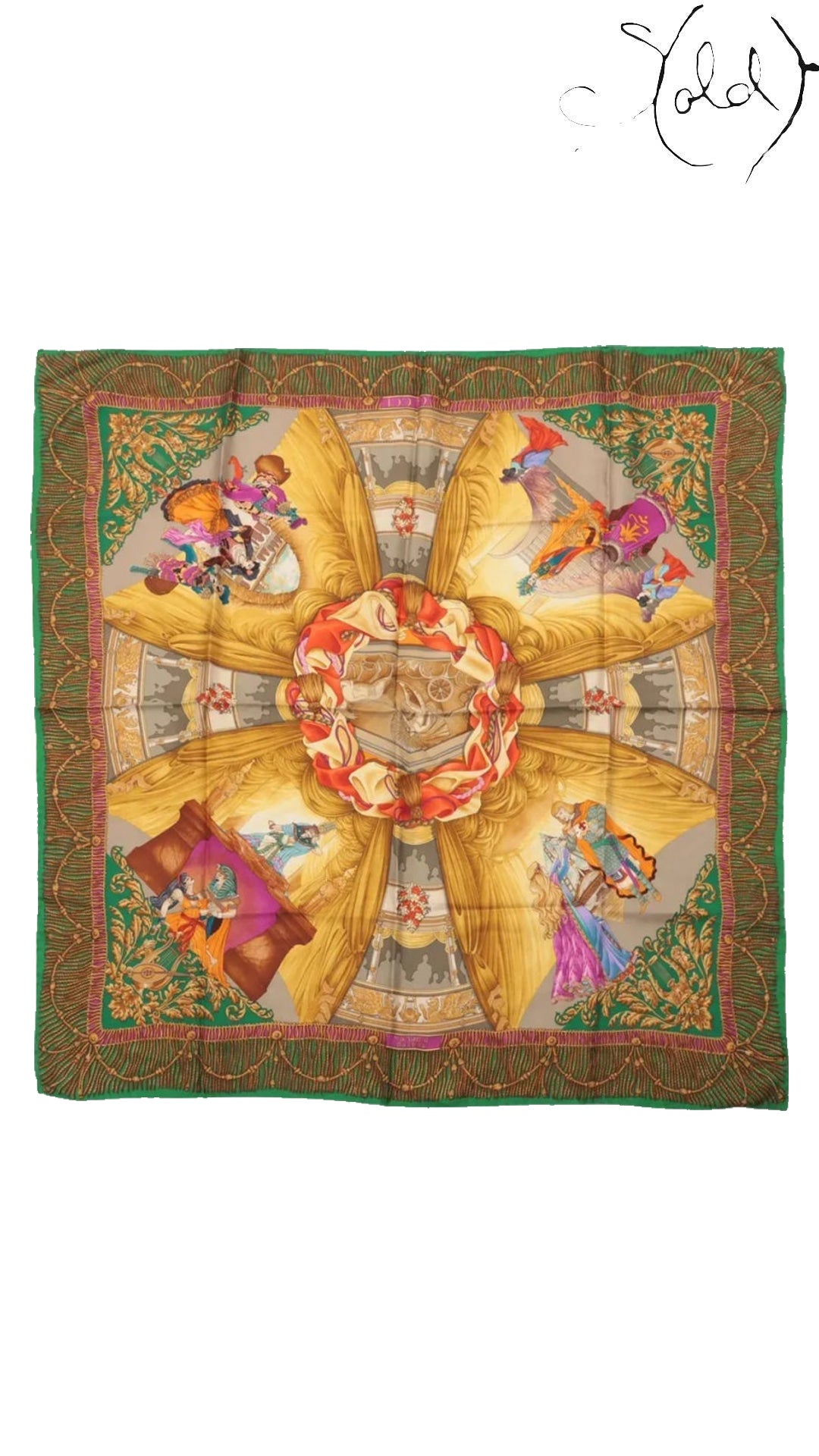
Hermès Harnais Français in grey, the scarf pictured on this guide, is a Sold Attire archive example and is currently sold. We would pair its grey border and cream field with a white shirt or navy tailoring. For a similar equestrian design, use Source a Piece.
Browse the current Hermès collection for availability, or study the Kosmima navy and khaki scarf as a colour and condition reference. Check the product page before reserving because each piece is one of one.
Current bag route: For pre-owned Hermes bags in Egypt, browse pre-owned Hermes bags in Egypt, then return to this guide for buyer guidance and comparison notes.
The Sold Attire Standard
- ✓ Japan-sourced pieces selected for condition, provenance, and collector value
- ✓ In-house authentication by Yahya before listing
- ✓ Lifetime money-back guarantee on authenticity
- ✓ Private showroom in New Cairo by appointment
- ✓ Next-day delivery across Cairo and Giza, with nationwide delivery available
Choose the drawing you want to live with, then inspect the silk well enough to know what you are buying.
Looking for an Hermès scarf in Egypt?
Send us the motif, size and colours you want, or ask for the next authenticated silk arrival.
Message us on WhatsAppResearch note: House history, the 1937 Carré 90, current silk formats and care guidance were checked against the Hermès house history, the maison's current silk collection and its official care guidance. Sold Attire product references are handled archive examples and are marked sold where applicable.








Leave a comment
This site is protected by hCaptcha and the hCaptcha Privacy Policy and Terms of Service apply.